November 24, 2026
Can You Get Urolithin A From Food? Pomegranates, Walnuts and Your Gut Bacteria
By the NAO editorial team · Every figure below was checked against the original published papers, listed at the end.
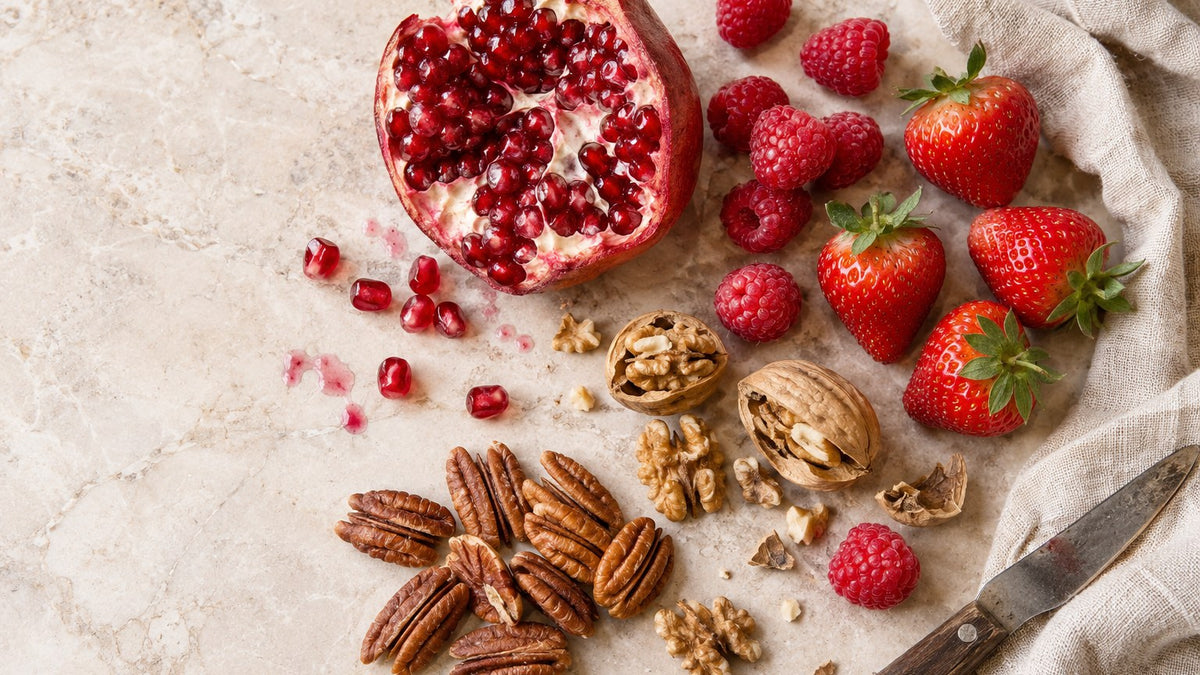
Not directly. Urolithin A is not found in food in any meaningful amount: your gut bacteria make it from ellagitannins and ellagic acid in pomegranates, raspberries, strawberries, walnuts and pecans. Whether that works depends on your microbiome. In a 100-person study, only 12% of adults had detectable urolithin A at baseline, and about 40% converted the precursors after drinking a glass of pomegranate juice.
The pomegranate has spent two decades as the poster fruit of healthy aging, and urolithin A is part of the reason. Yet the fruit never contained the compound at all. What it contains is a family of polyphenols called ellagitannins, and turning those into urolithin A is work that only certain gut bacteria can do. Some people carry the right microbes and some do not.
That small biological detail explains why two people can eat the same bowl of berries and walk away with very different results, and it is the main reason urolithin A supplements exist.
Key Takeaways
- Food gives you precursors, not urolithin A. Pomegranates, certain berries, walnuts and pecans supply ellagitannins and ellagic acid; gut bacteria convert them.
- Most people convert little or none. In a 2022 study of 100 adults, 12% had detectable urolithin A at baseline and roughly 40% converted significantly after about 240 mL (8 fl oz) of pomegranate juice.
- Your microbiome decides. Producers had a more diverse gut microbiome. Researchers group people into three "metabotypes", and age is the main factor shaping which one you are.
- Supplements skip the conversion. In the same study, 500 mg of urolithin A gave more than six times the exposure of the juice.
- Keep eating the foods anyway. They bring fibre and polyphenols whether or not you make urolithin A.
Where Urolithin A Actually Comes From
The journey has two stages. In the upper digestive tract, ellagitannins such as punicalagin, the signature polyphenol of pomegranate, break down into ellagic acid. In the large intestine, gut bacteria then transform ellagic acid step by step into a family of compounds called urolithins, of which urolithin A is the best studied.
Only a handful of bacterial species are known to do this work. Researchers in Spain identified Gordonibacter urolithinfaciens and Ellagibacter isourolithinifaciens as two human gut species that convert ellagic acid into urolithins, and other microbes appear to be needed to finish the job. If those species are missing or scarce, the precursors pass through largely unused.

Foods That Contain Urolithin A Precursors
| Food | What it supplies | Worth knowing |
|---|---|---|
| Pomegranate (fruit and juice) | Ellagitannins, especially punicalagins, and ellagic acid | The most studied source; used as the "challenge" food in urolithin research |
| Raspberries and blackberries | Ellagitannins | Raspberries have been tested in urolithin intervention studies |
| Strawberries | Ellagitannins | Also tested in urolithin intervention studies |
| Walnuts | Ellagitannins | The most studied nut source in urolithin research |
| Pecans | Ellagitannins | A nut source named alongside walnuts in urolithin research |
None of these foods hand you a set amount of urolithin A. The same serving can produce a lot, a little or none, depending on the bacteria in your gut.
The Pomegranate Juice Test
The clearest look at this problem comes from a study published in the European Journal of Clinical Nutrition in 2022. Researchers recruited 100 healthy adults and first measured whether they already had urolithin A in their blood. Only 12% did.
Participants then drank about 240 mL of pomegranate juice, roughly one glass, while the team tracked who turned its precursors into urolithin A. About 40% converted them in a significant way. The rest made little or none. When the scientists sequenced stool samples, the producers stood out for a more diverse gut microbiome and a higher ratio of Firmicutes to Bacteroides bacteria.
The trial was a crossover: after a washout of eight to fourteen days, every participant switched to the other arm, so each person also took 500 mg of urolithin A directly. Exposure to urolithin A was more than six times higher than after the juice, and far more consistent from person to person, because the supplement does not depend on anyone's bacteria. The study was funded by Amazentis, which makes the urolithin A used in the trial, a fact worth keeping in mind as you read the comparison.
Producer or Not? The Three Metabotypes
Scientists at Spain's CEBAS-CSIC research centre, including Francisco Tomás-Barberán and Juan Carlos Espín, have spent years mapping how people process ellagitannins. They describe three urolithin "metabotypes":
- Metabotype A: produces urolithin A as the main end product.
- Metabotype B: produces urolithin A along with isourolithin A and urolithin B.
- Metabotype 0: produces no final urolithins at all. The same research group estimates this applies to roughly one in ten people.
In a 2018 study of 839 people aged 5 to 90, the team concluded that age is the main factor determining which metabotype a person has. In other words, the gut bacteria involved in making urolithins change as we get older, the same years when interest in mitochondrial health tends to grow. Whether diet changes can reliably turn a non-producer into a producer has not been established.
The only way to know your own status is a lab test of blood, urine or stool after eating a precursor food. Most people never take one, which means most people who eat pomegranates for urolithin A are guessing.

Food or Supplement?
This is not an either-or choice. Pomegranates, berries and nuts are good foods with or without urolithin A, and nothing in this research suggests you should eat fewer of them. The question is narrower: if urolithin A itself is what you are after, can you count on your diet to deliver it? For most people, the data say no.
A supplement of preformed urolithin A removes the guesswork, because the dose arrives already made. That is how we built NAO Longevity+: each two-gummy serving delivers 250 mg of liposomal urolithin A, so it does not depend on your microbiome to make it, plus a 300 mg berry polyphenol blend and five more actives, including nicotinamide riboside, PQQ and L-BAIBA. For context, 250 mg is half the 500 mg dose used in the juice comparison above, and the six-fold figure was measured at 500 mg, so we do not apply it to our product. Every batch is tested by an accredited independent laboratory. You can read how we approach third-party testing for urolithin A.
The Bottom Line
You cannot get urolithin A from food directly, only its building blocks, and most adults convert those building blocks poorly or not at all. Eat the pomegranates and walnuts for everything else they offer. If you want a known daily amount of urolithin A, it has to come preformed. For what to expect once you start, read how long urolithin A takes to work, and for the bigger picture, our complete guide to urolithin A.
See NAO Longevity+ Liposomal Urolithin A Gummies → 250 mg preformed liposomal urolithin A per serving
Frequently Asked Questions
What foods contain urolithin A?
No common food contains meaningful urolithin A. Pomegranates, raspberries, blackberries, strawberries, walnuts and pecans contain ellagitannins and ellagic acid, which some people's gut bacteria convert into urolithin A.
Does pomegranate juice give you urolithin A?
Only if your gut bacteria can convert it. In a 100-person study, about 40% of adults converted pomegranate juice precursors into urolithin A in a significant way after one glass of about 240 mL.
Can everyone make urolithin A?
No. Researchers describe three metabotypes, and people in metabotype 0, estimated at roughly one in ten, produce no final urolithins at all. Many others produce only small amounts.
Do walnuts produce urolithin A?
Walnuts supply ellagitannins, a precursor. Whether they lead to urolithin A depends on your gut microbiome, and researchers have used walnuts in several urolithin studies for exactly that reason.
Is a urolithin A supplement better than food?
For getting a known amount of urolithin A, yes, because a supplement delivers it preformed. In one study, 500 mg of urolithin A gave more than six times the exposure of a glass of pomegranate juice. Food remains valuable for fibre and polyphenols.
Sources
- Singh A, et al. Direct supplementation with urolithin A overcomes limitations of dietary exposure and gut microbiome variability in healthy adults to achieve consistent levels across the population. European Journal of Clinical Nutrition, 2022. PubMed
- Cortés-Martín A, et al. The gut microbiota urolithin metabotypes revisited: the human metabolism of ellagic acid is mainly determined by aging. Food & Function, 2018. doi.org
- Selma MV, et al. Description of urolithin production capacity from ellagic acid of two human intestinal Gordonibacter species. Food & Function, 2014. pubs.rsc.org
- Tomás-Barberán FA, et al. Urolithins, the rescue of "old" metabolites to understand a "new" concept: metabotypes as a nexus among phenolic metabolism, microbiota dysbiosis, and host health status. Molecular Nutrition & Food Research, 2017. doi.org
These statements have not been evaluated by the Food and Drug Administration. This product is not intended to diagnose, treat, cure, or prevent any disease.